Design for Death
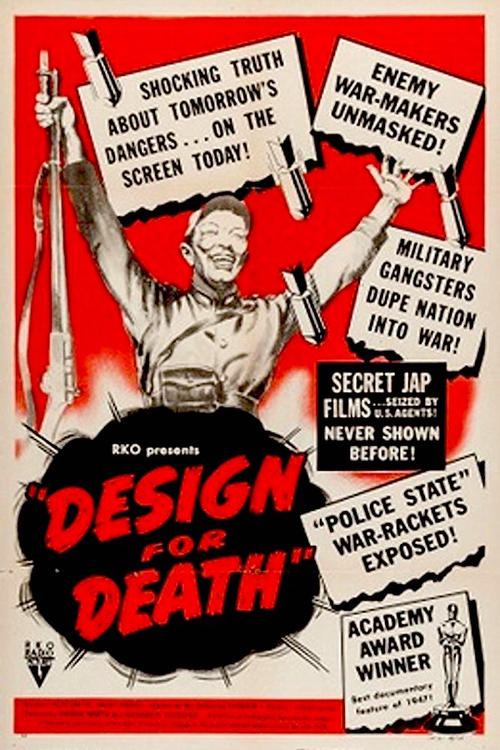
"Enemy War-Makers Unmasked!"
Design for Death takes a systematic look at how Japanese social structures, beliefs and institutions contributed to the nation's wartime choices in the 1930s and 1940s. Rather than sticking to battle reports, the film assembles archival footage, interviews and reconstructed scenes to outline... Read more
Where to Watch "Design for Death"
Not Currently Streaming
This title isn't available for streaming in the US right now.
Not Currently Available On (8 platforms)


Streaming availability last verified: January 14, 2026
About Design for Death
Design for Death takes a systematic look at how Japanese social structures, beliefs and institutions contributed to the nation's wartime choices in the 1930s and 1940s. Rather than sticking to battle reports, the film assembles archival footage, interviews and reconstructed scenes to outline education, religious influence and political pressures that shaped public opinion and policy. Narration guides viewers through cultural practices and state mechanisms without revealing later historical judgments, and its tone mixes scholarly summary with accessible narration, trying to make complex historical forces readable for audiences. The film emphasizes causes over chronology, aiming to connect everyday cultural norms to national decision making.
Directed by Richard Fleischer and released in the late 1940s, Design for Death was based on research and scripting contributions from Theodor Geisel, known as Dr. Seuss, and his wife Helen Palmer, who helped shape its narrative approach and distribution.
The film won the Academy Award for Best Documentary Feature, recognition that highlighted its timely subject and documentary style. The honor also prompted conversation about how nonfiction films represent foreign societies and wartime causes to domestic viewers, and it later came up in scholarly debates about documentary ethics and wartime messaging.
Because it involved Dr. Seuss and used a readable narrative, the film shaped American perceptions of Japan in the immediate postwar years and fed debates about propaganda, cultural interpretation and the responsibility of filmmakers in shaping collective memory. Its visuals and narration were later referenced by documentarians and critics alike.
Modern viewers and critics often find the film dated, and available ratings are modest, noting a 6.0/10 vote average from a small sample. It highlights themes of education, militarism, cultural conditioning and the ethics of representing another society during conflict. Audiences debate its methods, while historians say it's a snapshot.
Details
- Release Date
- June 10, 1948
- Runtime
- 48m
- Rating
- NR
- User Ratings
- 3 votes
- Type
- Movie
- Genres
- Documentary
- Country
- United States
- Studio
- RKO Radio Pictures
- External Links
- View on IMDB
Cast

Kent Smith
Narrator

Hans Conried
Narrator
Director: Richard Fleischer
Written by: Dr. Seuss, Helen Palmer