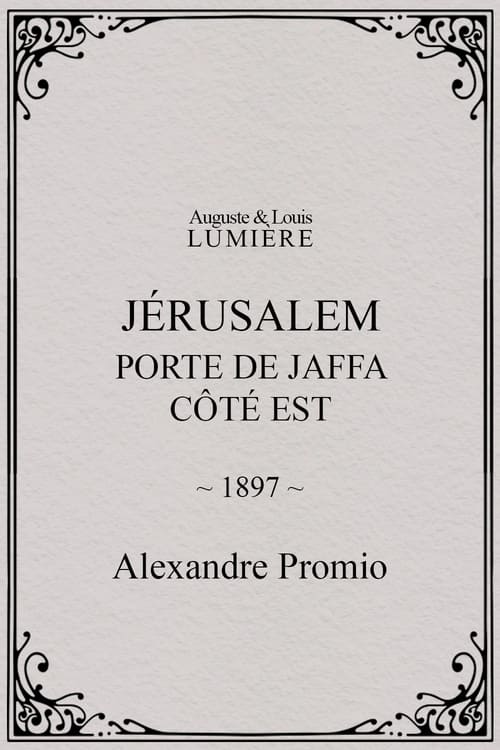
Jérusalem : porte de Jaffa, côté Est
A short, unadorned film from 1897 offers a direct look at life around the eastern side of Jerusalem's Jaffa Gate. Instead of a story, the camera records a sequence of street moments: people walking, carts moving, doorways and façades passing in a steady frame. There is no narration and no staged... Read more
Where to Watch "Jérusalem : porte de Jaffa, côté Est"
Not Currently Streaming
This title isn't available for streaming in the US right now.
Not Currently Available On (8 platforms)


Streaming availability last verified: January 14, 2026
About Jérusalem : porte de Jaffa, côté Est
A short, unadorned film from 1897 offers a direct look at life around the eastern side of Jerusalem's Jaffa Gate. Instead of a story, the camera records a sequence of street moments: people walking, carts moving, doorways and façades passing in a steady frame. There is no narration and no staged scenes, just continuous visual notes that show clothing, architecture, and ordinary interactions. The result is a time capsule feel, letting viewers observe everyday urban rhythms at the turn of the century and notice small details that photographic stills or written accounts might miss.
Directed by Alexandre Promio and released in 1897, this brief nonfiction piece comes from cinema's earliest years. It was filmed on location at Jaffa Gate and intended for short exhibition programs that treated moving pictures as novelties for public audiences.
As with many very early films, no reliable box office records survive for this short work. It circulated in late 19th century exhibition circuits and now exists mainly through archival preservation and museum screenings, rather than through any documented commercial run.
Though concise, the footage has long attracted historians and film scholars as a primary visual record of Jerusalem in 1897. Its unvarnished street scenes influenced early nonfiction filmmaking by privileging direct observation, and it often appears in retrospectives that trace how documentary and travel films developed in the silent era.
Contemporary reception is modest, a vote average of 5.3 out of 10 based on a small pool of votes, reflecting its status as archival material rather than mainstream entertainment. Scholars emphasize its value for what it shows about public space, movement, and material culture, noting that its significance lies more in historical documentation than in cinematic storytelling or aesthetic innovation.
Details
- Release Date
- April 26, 1897
- Runtime
- 1m
- User Ratings
- 14 votes
- Type
- Movie
- Genres
- Documentary
- Country
- France
- Studio
- Lumière
- External Links
- View on IMDB