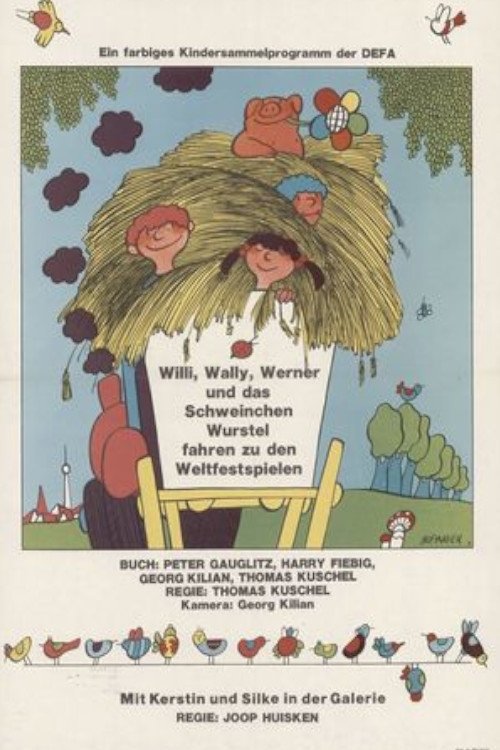
Willi, Wally, Werner und das Schweinchen Wurstel fahren zu den Weltfestspielen
"Ein farbiges Kindersammelprogramm der DEFA"
Three youngsters from a tiny Mecklenburg village hatch a plan to reach East Berlin and gift Angela Davis a lucky pig. The film follows their offbeat quest as they slip past the grown up world, chasing a symbol that blends friendship, curiosity, and political talk. What begins as a playful... Read more
Where to Watch "Willi, Wally, Werner und das Schweinchen Wurstel fahren zu den Weltfestspielen"
Not Currently Streaming
This title isn't available for streaming in the US right now.
Not Currently Available On (8 platforms)


Streaming availability last verified: January 14, 2026
About Willi, Wally, Werner und das Schweinchen Wurstel fahren zu den Weltfestspielen
Three youngsters from a tiny Mecklenburg village hatch a plan to reach East Berlin and gift Angela Davis a lucky pig. The film follows their offbeat quest as they slip past the grown up world, chasing a symbol that blends friendship, curiosity, and political talk. What begins as a playful ambition soon reveals worries about borders, rule breaking, and life under a country split in two. The camera stays close to their missteps and stubborn optimism, turning a street level prank into a lens on ordinary life under surveillance and ideology. Viewers meet Willi, Wally and Werner not as future leaders but as kids negotiating rules, cheering others on, and imagining a future beyond fences. A simple hopeful symbol.
Directed by Thomas Kuschel, with contributions from Georg Kilian Peter Gauglitz and Harry Fiebig, the film arrived in 1974 as a documentary rooted in East German cinema. It follows ordinary kids within a political frame with observational honesty for audiences.
Box office data for this title is not publicly available, and it did not become a major international hit. As a documentary from East Germany it circulated mainly in archival circles and festival contexts, with limited commercial footprint for scholars.
No major awards or nominations are documented for this obscure title. Its role seems centered on presenting youth perspectives rather than pursuing accolades, a stance found in some state financed documentary projects of the era. If any recognition occurred, it remains unrecorded in accessible archives. Any recognition would be modest.
Reception, as far as records show, treats film as a window into 1970s youth culture and state messaging. It centers on friendship and curiosity, while hinting at the lines that separate everyday life from political ideology. The approach invites viewers to think about how children imagine a future beyond borders.
Details
- Release Date
- April 19, 1974
- Runtime
- 42m
- Type
- Movie
- Genres
- Documentary
- Country
- XG
- Studio
- DEFA-Studio für Dokumentarfilme
Cast
Thomas Mackel
Willi
Gabriele Schröder
Wally
Ronald Köppel
Werner
Steffen Kerber
Kuno
Antje Fricke
Susi
Wilhelm Gröhl
Großvater
Harry Merkel
Polizist

Michael Narloch
Kraftfahrer
Günter Schubert
Busfahrer

Peter Dommisch
Fernsehkameramann
Director: Thomas Kuschel
Written by: Georg Kilian, Peter Gauglitz, Harry Fiebig